Share this article on Social Media:
At the Hospital C-Suite Summit 2026, amid the case studies and cautionary tales, something practical kept surfacing: named, repeatable frameworks that leaders could take home and use. Not theories, but structured ways of thinking – for adopting AI, governing it ethically, securing it, and measuring whether it’s working. Here are six of the most useful, drawn from the stages of HC-S 2026.
Most conference takeaways are impressions. But a handful of speakers at HC-S 2026 offered something more portable – frameworks you can actually put to work on Monday. We’ve gathered six of the best, with the leaders who presented them and where they come from.
1.PULSE – a strategy for scaling AI across a system
Presented by Kenneth Kwek, Deputy Group CEO for Digital and Future Health at SingHealth, in Session 1.
For organizations trying to move beyond scattered pilots to system-wide adoption, SingHealth’s PULSE framework offers a checklist of five pillars:
● Platforms (unified digital infrastructure)
● Upskilling (building AI literacy across the workforce)
● Lean processes (redesigning workflows, not just digitizing them)
● Strategic partnerships
● Ethical governance
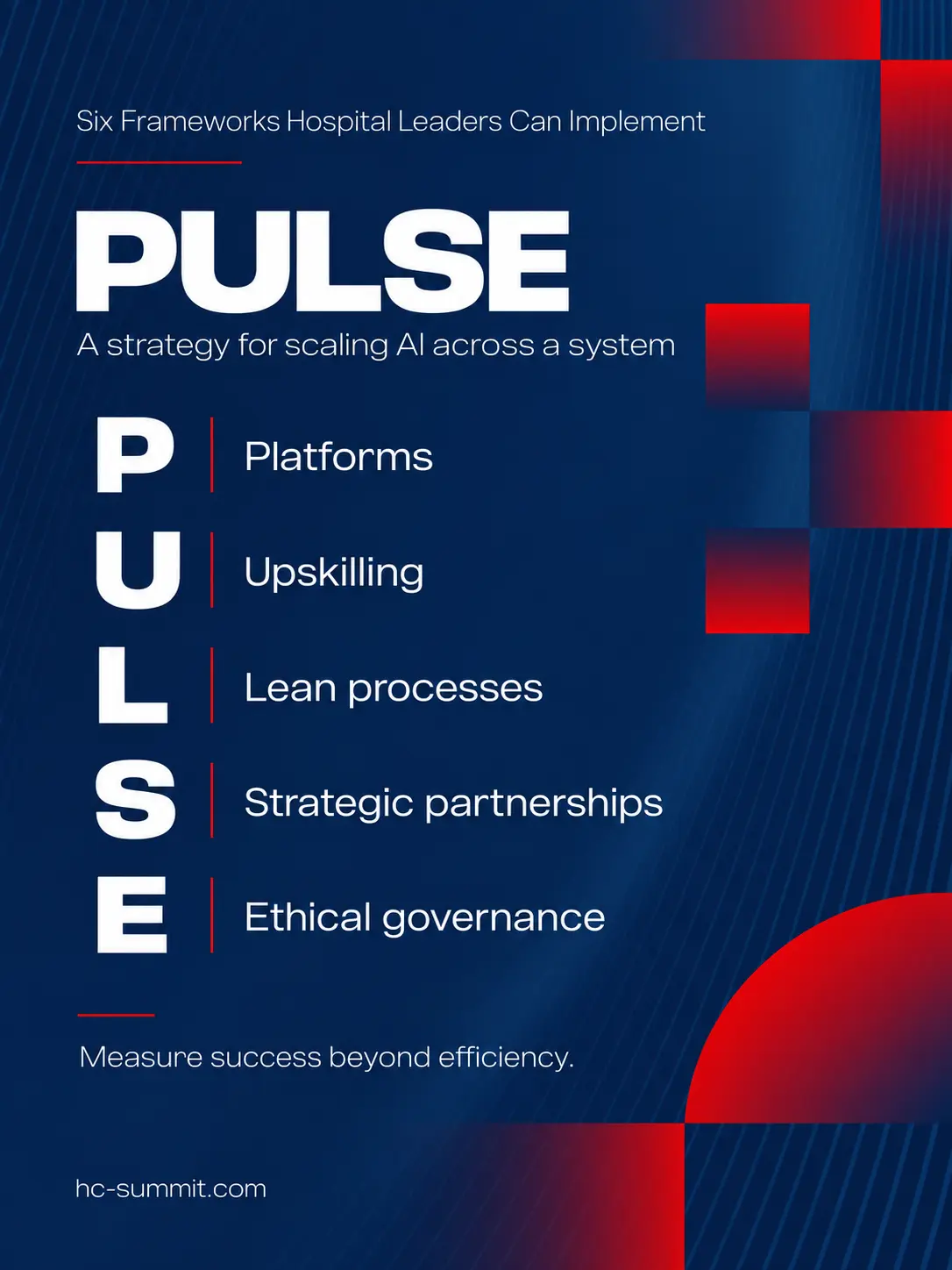
What makes it more than an acronym is how success is measured, not by efficiency alone, but by clinical quality, patient experience, research impact, and workforce wellbeing. Use it as a diagnostic: which of the five is your weakest link?
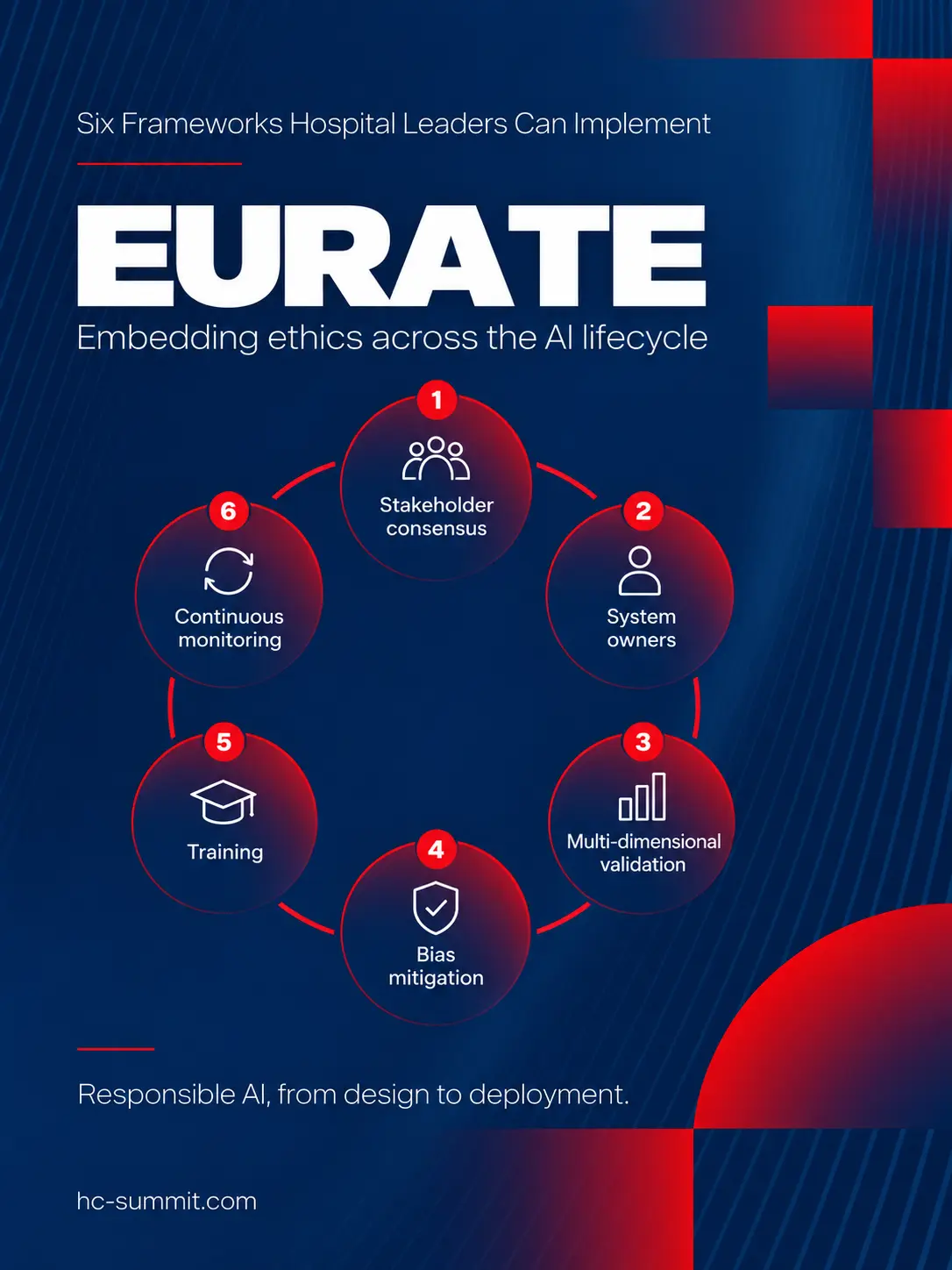
2. EURATE – embedding ethics across the AI lifecycle
Presented by Anke Diehl, Chief Transformation Officer at University Medicine Essen in Session 2.
EURATE is a framework for responsible AI, grounded in European values and aligned with the EU AI Act. Rather than treating ethics as a final compliance check, it embeds it across the whole lifecycle: securing stakeholder consensus at the outset, defining AI “system owners” as multidisciplinary teams, running multi-dimensional validation (technical, clinical, usability, regulatory, and ethical), mitigating bias, mandating training, and monitoring continuously for model drift. Its practical value is that it applies whether you build AI in-house or buy it off the shelf – turning “are we being responsible?” into a concrete, auditable process.
3. “Eyes, Brain, Hands” – securing AI before you deploy it
Presented by Mickey Boodaei, CEO and co-founder of Transmit Security, in Session 5.
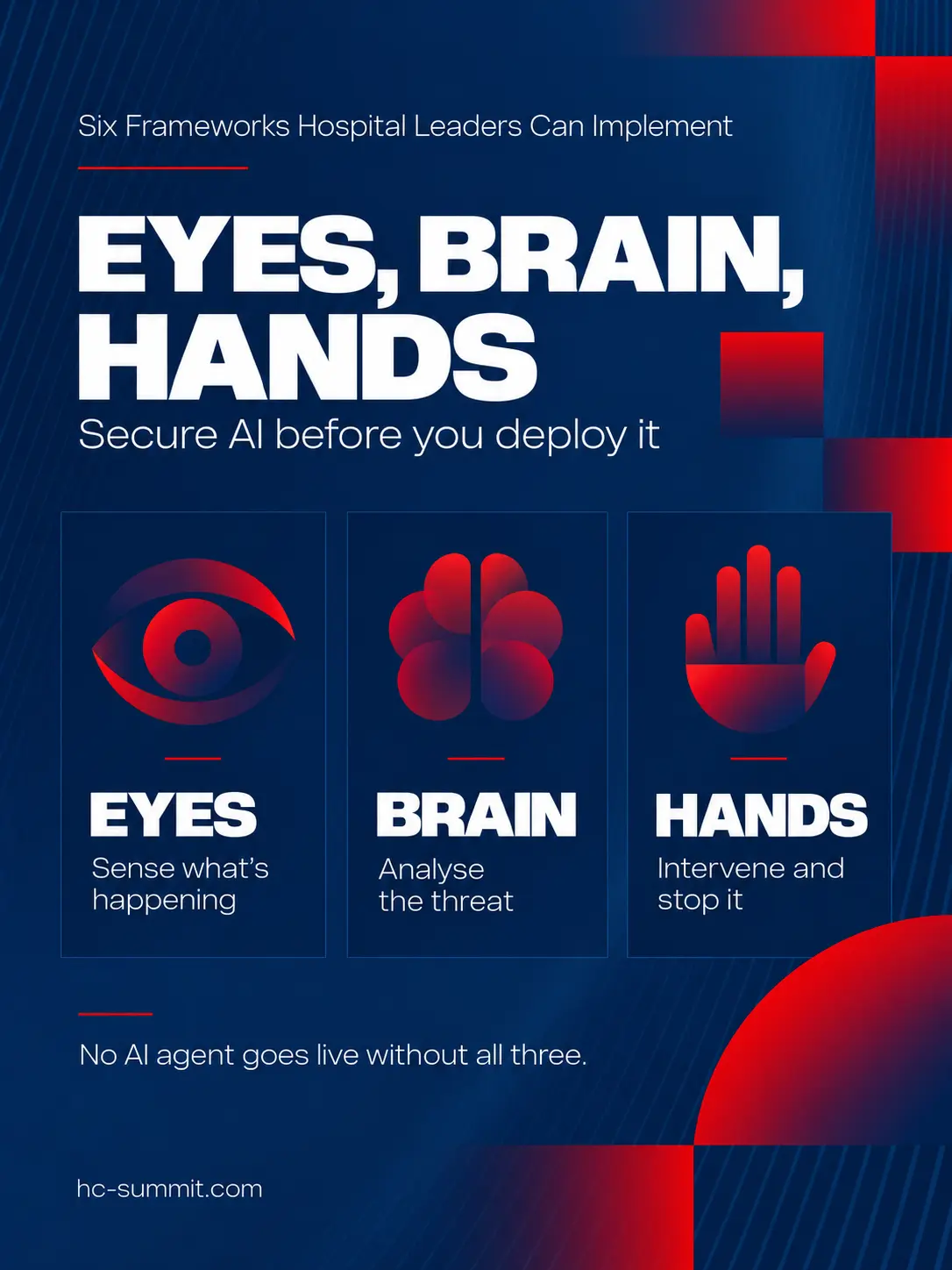
Boodaei’s security model treats AI as a manipulable “digital employee” rather than predictable software, and builds defense in three layers:
● Eyes (collect the contextual data to sense what’s happening)
● Brain (analyze it to identify a threat)
● Hands (intervene to stop it)
The critical rule is timing – this has to be in place before an AI system is rolled out, not retrofitted after something goes wrong. Use it as a gate: no agent goes live until it has eyes, brain, and hands around it.
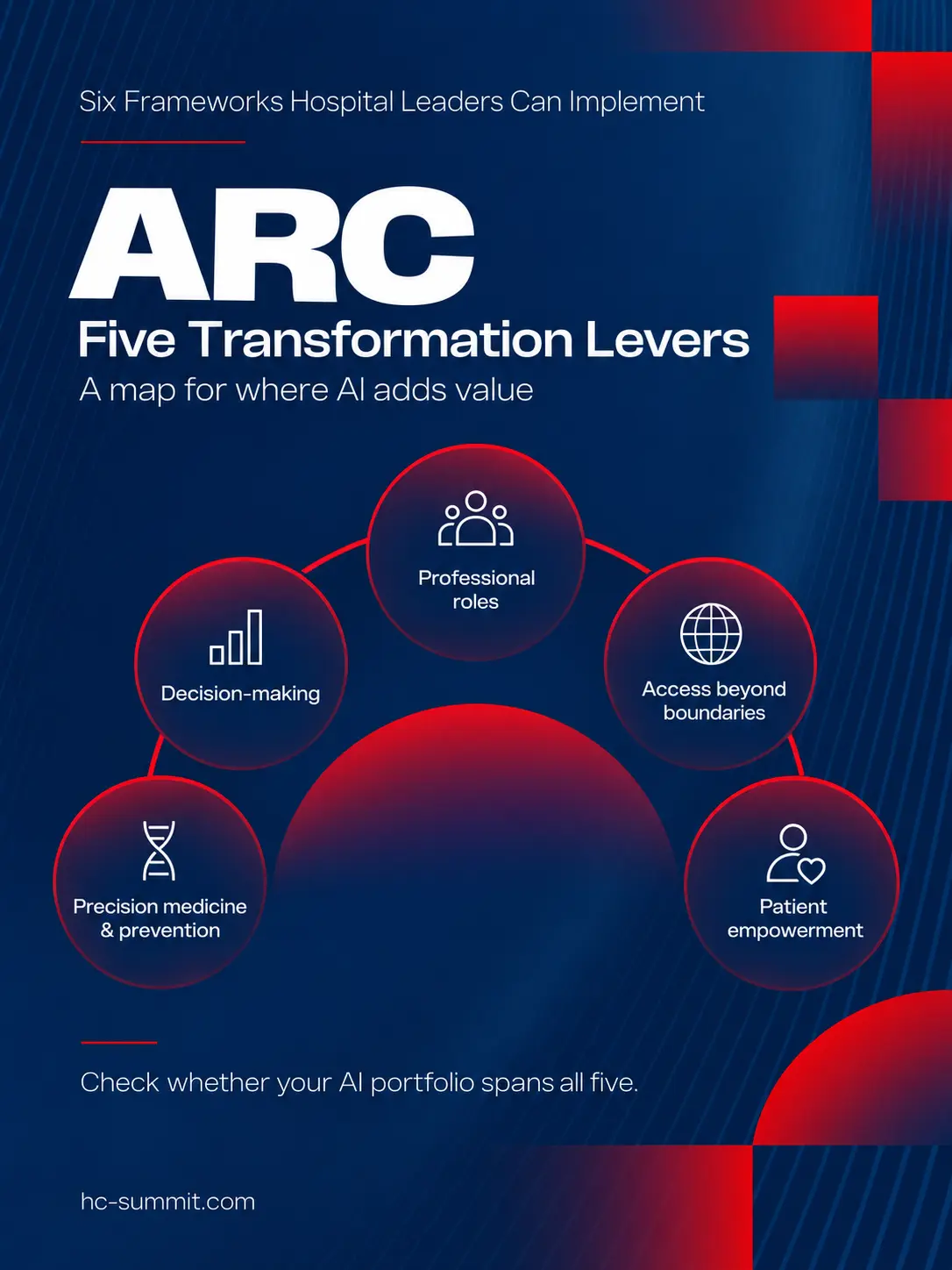
4. ARC’s Five Transformation Levers – a map for where AI adds value
Presented by Eyal Zimlichman, Chief Innovation, Transformation & AI Officer and founder of ARC at Sheba Medical Center, in Session 1.
To avoid deploying AI at random, Zimlichman offered five pathways where transformation actually happens: improving decision-making, redesigning professional roles, expanding access beyond geographical boundaries, accelerating precision medicine and prevention, and empowering patients in their own care. AI is the connective thread across all five. The framework works as a portfolio check – are your AI initiatives spread across these levers, or clustered in just one?
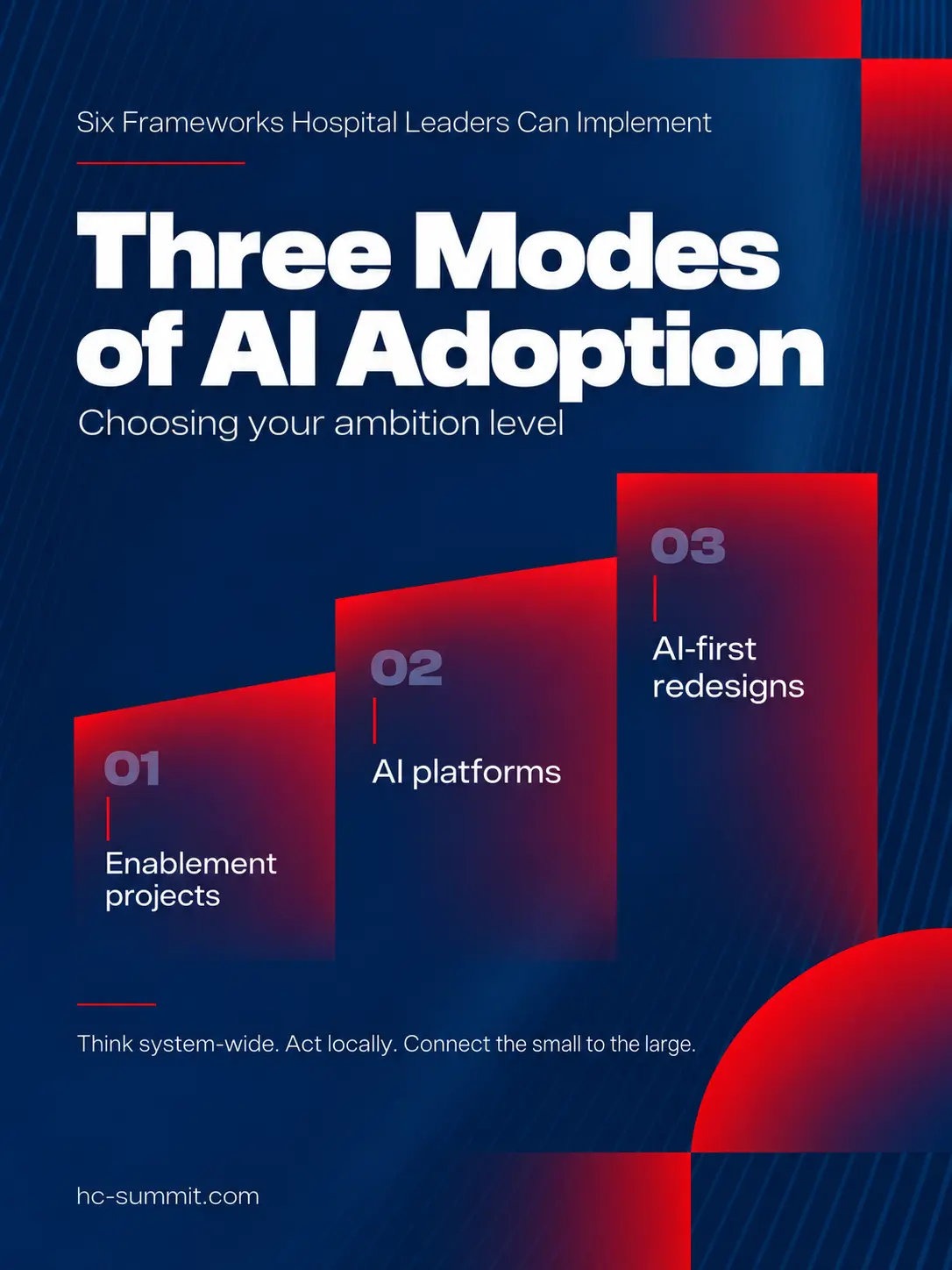
5. Roche’s Three Modes of AI Adoption – choosing your ambition level
Presented by Okan Ekinci, Roche Information Solutions, in Session 1.
Ekinci mapped three routes to adopting AI: small enablement projects that solve specific operational problems, enterprise-wide AI platforms that support many use cases, and full AI-first redesigns that rebuild workflows and operating models from the ground up. The danger lies at both extremes – pilots that never scale, and top-down mega-programs too rigid to adapt. The framework’s value is in naming your current mode honestly, then deciding where you need to be. His guiding principle: think system-wide, act locally, and connect small projects to larger ones.
6. The Productivity Paradox – a reality check for AI business cases
Presented by Anna van Poucke, founder of Global Health Transformers, in Session 2.
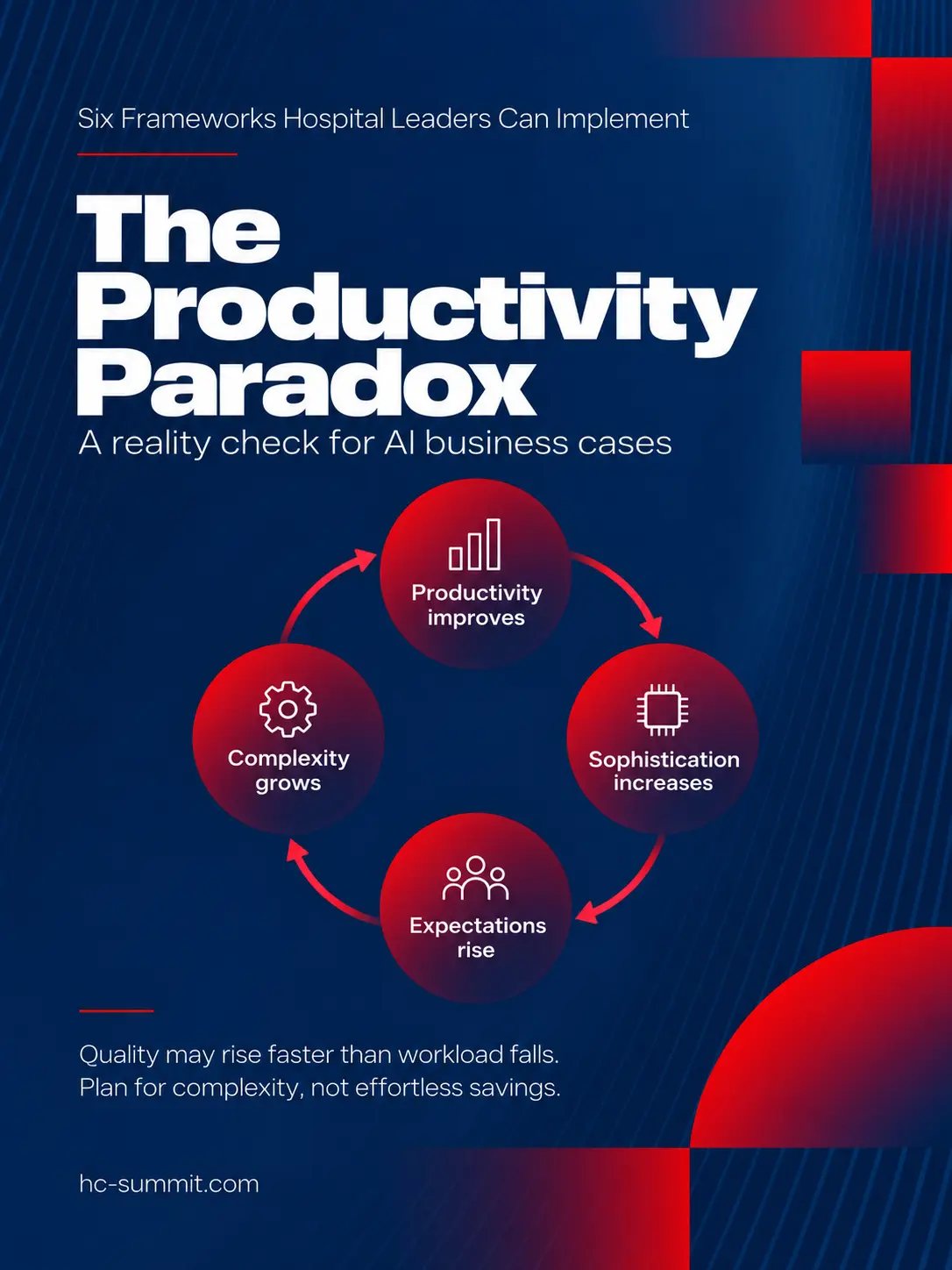
Not a process but a mental model, and a corrective for over-optimistic ROI. Borrowing from the automotive industry, van Poucke’s paradox runs: productivity improvements enable sophistication → sophistication raises expectations → expectations raise complexity → so cost per unit can rise even as productivity “improves.” The lesson for leaders is to expect AI to raise quality faster than it cuts workload, and to plan for rising complexity, and protected “slow time”, rather than banking on effortless savings.
The Takeaway
The value of a summit isn’t just inspiration – it’s the tools you can use afterward. Taken together, these six frameworks form a rough operating manual for the AI-enabled hospital: ARC’s levers to decide where to act, Roche’s three modes to set your ambition, PULSE to scale it, EURATE to keep it ethical, “eyes, brain, hands” to keep it secure, and the productivity paradox to keep your expectations honest.
Pick the one that closes your biggest gap and start there.
Want to stay informed about the ideas shaping the future of healthcare leadership? Subscribe to our newsletter and be the first to hear about insights, speaker announcements, and updates from the next Hospital C-Suite Summit.
Share this article on Social Media: