Share this article on Social Media:
At the Hospital C-Suite Summit 2026, the value-based healthcare session marked a turning point: after years of promising pilots, leaders showed how outcome measurement, payment reform, and population-based models are moving into everyday operations. The common ingredient? Standardized data and the discipline to compare, benchmark, and learn across borders.
Value-based healthcare has been discussed for over a decade. Session 4 “Value-Based Healthcare 2.0: Population-Based Models” asked what has actually changed: where is value-based care producing measurable results at system scale, and what does it take to get there?
With the global market for value-based healthcare services projected to roughly double to $6.8 billion, the appetite for operationalization is clear. The speakers explained what separates the systems making it work from those still stuck in pilot mode.
You Can’t Improve What You Can’t Compare
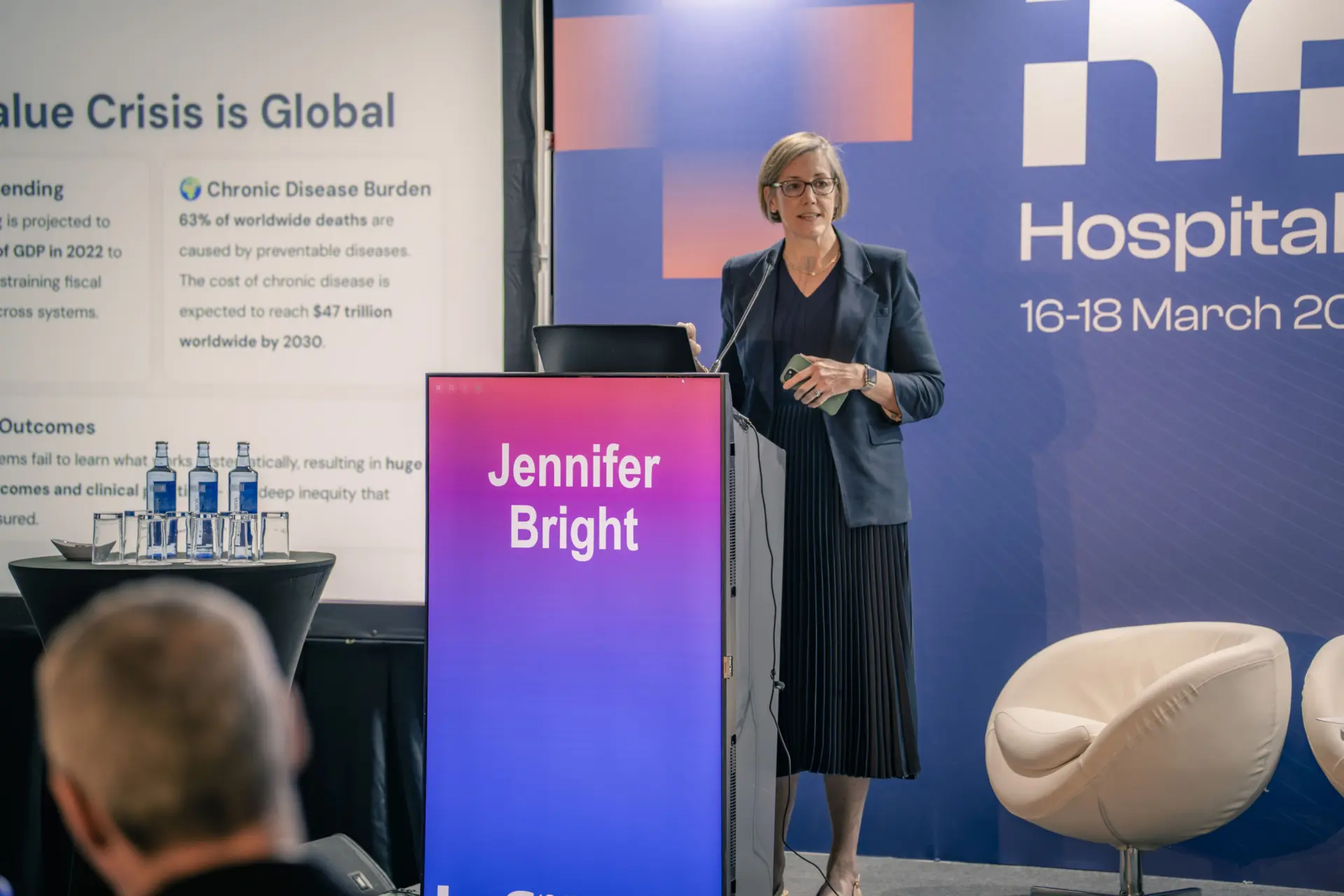
Opening the session, Jennifer Bright, President & CEO of the International Consortium for Health Outcomes Measurement (ICHOM), made the foundational case: transformation stalls without standardized, comparable outcomes. ICHOM’s approach combines clinical and patient-reported measures, developed by international working groups in which 25–30% of participants are people with lived experience, and published open-access and peer-reviewed. She pointed to results from Thailand, Mexico, and Australia – improved patient-reported outcomes, lower costs, better pathways – and to accreditation programs that help hospitals embed measurement into routine care. On AI, she offered a caution: it can accelerate outcome capture, but only if trained on appropriate standardized data rather than misleading claims-based signals.
What a Registry Culture Makes Possible
Frieder Braunschweig, Director of Cardiology at Karolinska University Hospital, showed how Sweden’s decentralized, tax-funded system – underpinned by more than 100 national quality registries – enables longitudinal follow-up and honest benchmarking. He was candid about the false starts: Karolinska’s 2016 reorganization around medical conditions created new silos and strained IT systems before being recalibrated. What endured was co-shared leadership between physicians and nurses in a multidisciplinary Heart and Vascular Center, and registry-driven improvement that lifted underperforming areas. The next frontier, he suggested, is continuous patient monitoring that folds patient-reported outcomes into proactive, personalized care.
Lessons From the World’s Largest Care-Coordination Experiment
Purva Rawal, of the CMS Innovation Center, brought the US perspective, drawing on nearly 60 payment models tested at national scale. Population-based models, she argued, have improved care coordination and delivered modest but real cost savings – and produced valuable “spillover,” where infrastructure built for one model benefits patients well beyond it. She named three enablers for scaling: multisectoral partnerships, actionable data and digital health, and rapid evidence generation. Accountable Care Organizations – the largest care-coordination program in Medicare’s history – point toward coordinated, whole-person care as the baseline, including deliberate attention to social determinants of health.
Doing Better With Less
Rasmus Møgelvang, CEO at Rigshospitalet in Copenhagen, described Denmark’s shift from activity-based financing to fixed budgets with value-based priorities – a cultural move toward “doing better with less.” Rather than rewarding volume, the system actively hunts for low-value care to eliminate, using platform trials embedded in everyday clinical practice to test what genuinely helps. Crucially, he framed this as a shared Nordic effort: through the Nordic University Hospital Alliance, systems accelerate learning and avoid reinventing solutions each in isolation.

Governing for Quality – Even Without Outcome-Based Payment
Maria Rocca, Head of Quality and Safety Culture and Hospital Risk Management at Humanitas Group, demonstrated that rigorous quality governance pays off even in a system, like Italy’s, without outcome-based reimbursement. Humanitas’s custom platform tracks more than 600 KPIs, with dashboards at hospital, unit, clinician, and pathway level and preventability alerts on individual cases. Multidisciplinary mortality committees have reduced elective surgical mortality even as patient complexity has risen, and the group outperforms national risk-adjusted benchmarks in oncological surgery. Her analysis of the direct and hidden costs of quality failures made the business case plainly: better quality is cheaper.

Scaling Beyond a Single Hospital
Bringing an industry lens, Jeppe Høyholt, of Medtronic, described partnerships with more than 300 hospitals that pair devices and clinical expertise with digital tools, AI, and new commercial models – risk-sharing tied to clinical and patient-reported outcomes, subscription-based payments, and AI-supported treatment selection. Using aortic stenosis as an example, he positioned industry as a “scaling engine” for proven best practice, provided the focus stays on implementation, not just technology.

The Takeaway
Value-based care, this session argued, is no longer a philosophy in search of proof. From Swedish registries and Danish budget reform to Italian quality governance and US population models, the building blocks are in place – and they share a common core: standardised outcomes, transparent benchmarking, and relentless cross-border learning.
The systems moving fastest aren’t waiting for a perfect payment model. They are measuring what matters, comparing honestly, and eliminating what doesn’t work.
Want to stay informed about the ideas shaping the future of healthcare leadership? Subscribe to our newsletter and be the first to hear about insights, speaker announcements, and updates from the next Hospital C-Suite Summit.
Share this article on Social Media: