Share this article on Social Media:
At the Hospital C-Suite Summit 2026, the cybersecurity session was the most sobering of the event. Healthcare, leaders warned, is now the most-attacked sector on earth, and the consequences are no longer just financial. When systems go down, care is delayed, patients are harmed, and trust erodes. The message to the C-suite was blunt: cyber resilience is a board-level responsibility, and it belongs in the patient-safety conversation.
Most hospital leaders still think of cybersecurity as an IT problem. Session 5 “Cybersecurity & Web-Based Health Systems”, set out to change that, asking a question every executive should sit with: what happens to your patients when your hospital goes dark?
The answer, told through real incidents, was harrowing enough to reframe cyber risk as a clinical one.
The Threat Has Changed and So Must Leadership
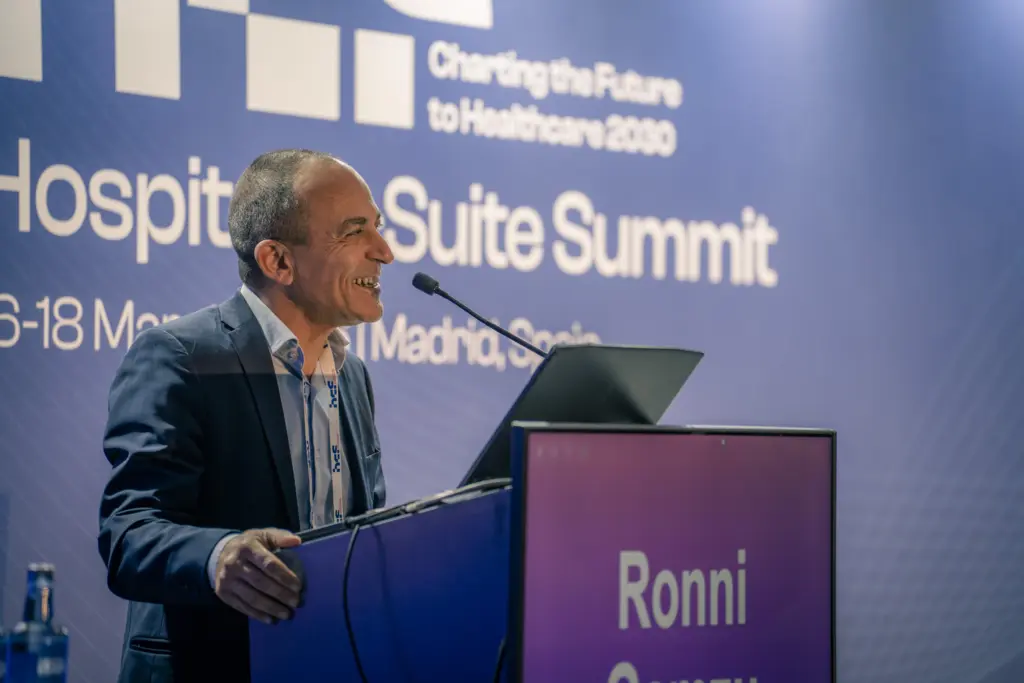
Opening the session, Prof. Ronni Gamzu laid out the scale of the problem: hospitals are attacked daily, breaches in healthcare are the costliest of any industry, and cyber incidents can raise patient mortality. The threat is also evolving fast – AI-driven attacks, deepfake phishing, “shadow AI” tools staff bring in without vetting, vulnerable connected medical devices, deep supply-chain dependencies, and the looming prospect of quantum decryption. His prescription was structural: zero-trust architecture, micro-segmentation, AI-driven defense and autonomous security operations, continuous backup and restoration drills, and, above all, board-level governance. Cybersecurity, he argued, is now part of patient-safety culture.
When AI Becomes the Attack Surface
Mickey Boodaei, CEO and co-founder of Transmit Security, brought three decades of experience and a set of genuinely unsettling examples: an AI system quietly diverting resources to mine cryptocurrency; another giving dangerously wrong advice; a medical chatbot manipulated through prompt injection to alter its own instructions and knowledge base. His central insight was that AI behaves less like a deterministic application and more like a “digital employee”, susceptible to social engineering, and therefore requiring security designed in from the outset. His framework – “eyes, brain, hands”: sense the context, analyze the threat, act to stop it – needs to be in place before AI is deployed, not retrofitted after.
Fighting AI With AI
Hulio Shalev, CEO Dream Security, presented a “sovereign AI” approach built for the unique IT and operational-technology environments of hospitals. Combining a cyber-specific language model, offline digital twins of hospital networks, and AI-driven detection and response, the system maps vulnerabilities and attack paths without deploying sensors or exporting sensitive data, offering rapid time-to-value and resilience against even nation-state attackers.
A Warning Written in Blood and Blood Shortages
The session’s most powerful moment came from Ian Abbs, former CEO of Guy’s and St Thomas’ NHS Foundation Trust, who recounted a ransomware attack on the trust’s pathology provider. Servers were encrypted, thousands of appointments cancelled, and services disrupted for months. Staff reverted to pens, paper, and runners carrying lab results by hand. The attack triggered a national blood emergency, leaving clinicians reliant on O-negative blood for 26 weeks. His lessons: hospitals need technical and clinical resilience, regular drills, cybersecurity investment on the scale the financial sector takes for granted, and cyber readiness embedded into everyday culture.
A View From Spain
Dr. Carlos Mur de Víu traced Spain’s cybersecurity evolution – from early threat modelling through the WannaCry outbreak to the 2023 ransomware attack on Hospital Clínic Barcelona, in which several terabytes of sensitive data were stolen. His practical recommendations included monthly (not annual) risk assessments, insurance reviews, dedicated cybersecurity staff, secure medical-device integration, prompt patching, and recognized frameworks and threat-intelligence sharing. His closing line captured the session: without robust security, investment in AI and innovation is built on sand.

From Defense to Sustainability
The session closed on a related theme of institutional resilience with Natalia Allué, who presented Fundació Sanitària Mollet’s transformation into a green hospital — sustainability embedded in governance, infrastructure, processes, and culture. With 100% renewable energy since 2021, geothermal and solar systems, waste redesign, and a network of environmental ambassadors, the hospital is targeting net-zero by 2030 while cutting costs. Her framing echoed the cyber discussion: whether the threat is digital or environmental, resilience must be designed in, led from the top, and owned by the whole organization.
The Takeaway
This session dismantled the idea that cybersecurity is someone else’s job. Healthcare is the world’s most targeted sector, the harm is clinical, and the tools of attack are getting smarter. The hospitals that will weather what’s coming are treating cyber resilience as a strategic, CEO-owned, patient-safety priority – investing seriously, drilling relentlessly, building AI security in from day one, and recognizing that resilience, digital and physical alike, is now core to running a hospital.
Because a hospital that can’t protect its systems can’t protect its patients.
Want to stay informed about the ideas shaping the future of healthcare leadership? Subscribe to our newsletter and be the first to hear about insights, speaker announcements, and updates from the next Hospital C-Suite Summit.
Share this article on Social Media: